You Are Building Your Strategy Wrong
Joe Crabtree
October 30, 2026 · 8 min read
The board wants an AI strategy. Three executives each open their favorite chat and build one. They spend an hour arguing about which is best, the team turns the meeting notes into 30 confident sounding slides, and everyone approves. Three months later the board asks for a status, and nothing has changed.
What a time to be alive. I have sat in that meeting, minus the AI chat, more times than I want to count. The AI just gets you there faster, and it makes it harder to see what went wrong.
I try hard not to tell people they are doing it wrong. Most of the time there is more than one right way, and the person doing the work knows things I do not. This is an exception.
If your strategy starts in a chat window, you are building it wrong.
Not because the model is bad. I wrote in August that the prompts genuinely work. The problem is that a chat window is a conversation, and strategy is a process. When you use a conversation to do the job of a process, you get something that reads like a strategy and behaves like an opinion.
Easy is not the same as right
The appeal is obvious. You open a chat, describe your business, and four minutes later you have objectives, initiatives, and a roadmap. It feels like progress, and in one sense it is. You have more words than you had before.
What you do not have is direction. Direction is what tells two hundred people which way to lean on decisions you will never see. A chat answer can't give you that, no matter how smart the model is.
It gave you the average answer. A general model produces the most likely response to your description. The most likely strategy for a company like yours is, by definition, the one your competitors will get too. Ask it how to differentiate and you will get the most common description of differentiation.
It answered one person. The person typing. Finance, operations, sales, IT, and HR were not in the conversation, so their constraints are not in the answer, and they will discover the plan does not fit them about three weeks after it is announced.
It has no idea whether it is right. The model has never seen whether its last hundred recommendations worked. The confidence is in the writing, not in the evidence.
Chat made the first hour easier. It made every hour after that harder.
Strategy is a process
Every strategy I have seen actually work went through a similar set of questions, asked with purpose, where the answers feed each other. There is a natural order to them. It is hard to cost work you have not named, or measure a benefit nobody agreed to.
But the order is a guide, not a rule. Plenty of organizations start in the middle, with a business case that is already funded or a risk that cannot wait, and still succeed. What they do not skip is connecting the answers. Wherever you start, each answer has to tie back to the others, or you end up with a pile of good ideas that do not add up to a strategy.
A process does not much care which tool you use for any single step. It cares that the steps happen, that the right people are in each one, and that the answers are kept somewhere everyone can see. A chat thread fails all three.
Here is the process we built Analyzt AI around, and where the human and the machine each sit in it. The steps are numbered, but your team can move between them as the work demands.
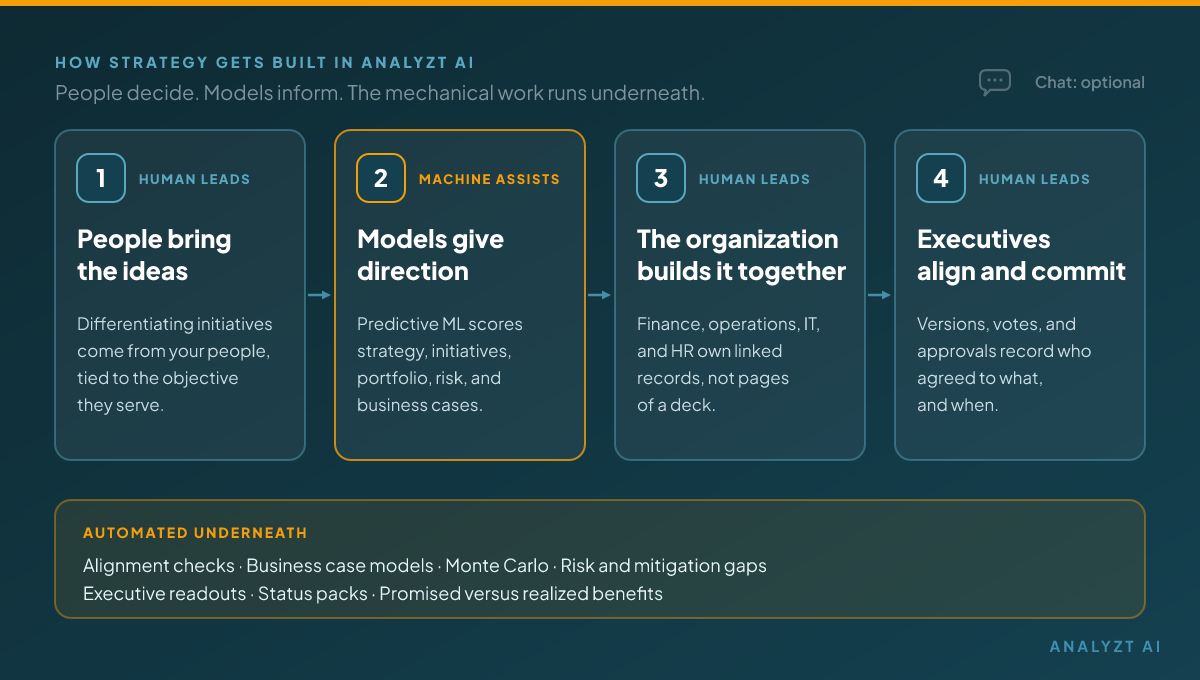
1. People bring the ideas that make you different
The initiatives that separate you from the company down the street come from your people. The operations lead who knows which plant could run a second shift. The sales director who has heard the same complaint from six customers. The product manager whose idea got dismissed two years ago and suddenly makes sense.
That is ingenuity, and it is the one part of strategy a competitor cannot buy from the same vendor you did. So we do not generate your initiatives. Analyzt AI gives your people a structured place to propose them, ties each one to the objective it serves, and checks the structure: what is orphaned, what is duplicated, where the dependencies sit. The idea is yours. The bookkeeping is ours.
2. Machine learning gives direction, not certainty
Once the ideas exist, the question becomes which ones to back. This is where most planning processes fall back on whoever argues best in the room.
Analyzt AI scores your strategy, initiatives, portfolio, risks, business cases, and value realization with predictive machine learning models trained on outcomes. Predictive, not generative. They do not write you a paragraph about why an initiative sounds promising. They tell you how likely it is to deliver, how confident they are, and which factors are driving the number.
That is direction. It is not a verdict. A 62 percent score does not tell you to kill an initiative. It tells you where to look before you fund it. Every score comes with a plain language explanation of what it implies, why it matters, and why you should question it. The executive still makes the call. They just make it with a compass instead of a hunch.
3. The organization builds it together
A strategy written by one function is a plan for that function. Finance knows what the business can afford. Operations knows what it can actually deliver. IT knows what the systems will and will not do. HR knows who is available. If any of them meets the plan for the first time at the announcement, the plan has already started to fail.
In Analyzt AI the strategy is a shared record, not a document someone emails around. Every objective, initiative, business case, and risk has an owner. People comment on the specific thing they disagree with, not on page fourteen of a deck. The business case finance built links to the initiative operations is delivering and the risk IT raised against it. When one of them moves, the others show it.
4. The executives align before anything moves
This is the most difficult step for most organizations, and it is the one that drives everything else.
If the executive team does not actually agree on the direction, no amount of planning downstream will save it. Each leader quietly executes their own version, and the organization spends the year reconciling them. That is the meeting in the joke, held every quarter.
Analyzt AI makes the agreement explicit. Version history on the strategy, comment threads on specific versions, voting sessions, and approval flows, so a leadership team can see where it actually disagrees and converge on a decision it will be held to. The record shows who agreed to what, and when. Nobody gets to remember it differently next quarter.
The machine does the mechanical parts
None of this means more work for your people. It means the work goes to the right place.
The mechanical parts of strategy, Analyzt AI automates. Building the financial model behind a business case, applying benchmarks, and running Monte Carlo analysis on the assumptions. Finding the risks you have not listed and the gaps in the mitigations you have. Checking that every initiative traces to an objective. Writing executive readouts from live data. Rebuilding the status pack every period so nobody loses a week to slides. Tracking promised benefits against realized ones.
What is left for the humans is the part that was always the job. Having the idea. Weighing the evidence. Arguing it out. Committing.
So where does chat fit?
Of course we have AI chat in Analyzt AI, and it is optional. You can open a discovery session, explore a question, and share it with your team. Some people like to think out loud that way, and that is fine.
But nothing in the process depends on it. You do not have to describe your company to a chat window, because your company is already in the system. The AI runs when someone clicks the button that asks for it, against your actual records, and puts its output where everyone can see and challenge it. The strategy does not live in a conversation. The conversation, if you have one, lives next to the strategy.
That is the difference. In a chat window, the conversation is the process. In Analyzt AI, the process is the process.
Doing it right is now the easy way
Running a real strategy process used to be much harder than typing into a chat window. That was a fair reason to cut corners. It is not true anymore.
The mechanical work is automated. The ideas, the scores, the collaboration, and the executive decision all happen in one place. What used to take an offsite, a consulting team, and two months of slide revisions is now a process your team can actually run.
You can keep asking your favorite chat for a strategy. It will keep giving you a confident one. Just do not be surprised when your COO's AI chat gives them a different one, and you all end up in the meeting.
Something bigger is coming. Analyzt AI general availability lands in November, along with a practical guide to running this process, question by question, for the people who run it. Follow Analyzt AI on LinkedIn to see it the day it launches.
If you want in before then, the beta is open for one more week. And if you run a consulting firm, we have a partner program.
About the author
Joe Crabtree is the founder and CEO of Analyzt AI. He spent more than 20 years in strategy and transformation consulting, including over seven years at Avanade, an Accenture company, before building Analyzt AI to give organizations consulting rigor and strategy execution in one AI scored platform.
Connect on LinkedInSee how Analyzt AI puts this into practice.
Join the Beta